

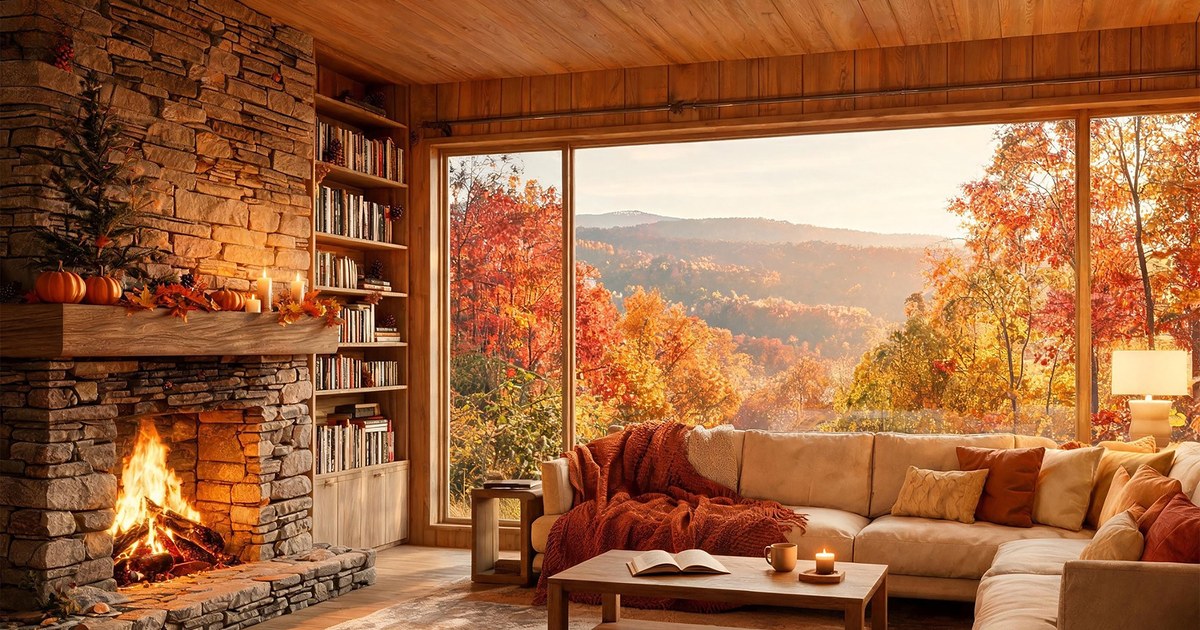
An occupied home in Central PA cycles between roughly sixty five and seventy five degrees all year, and flooring handles that easily. A hunting camp near Raystown, a cabin up toward Blue Knob, or a seasonal place that gets drained and shut down in the autumn is a completely different environment. That building follows the outside temperature from well below freezing in January to warm and humid by June.
That is a genuinely different engineering problem, and a lot of flooring sold for houses is not specified for it. Cove Flooring & Design LLC fields this question every autumn as people close places up.
Why an unheated building is not just a cold house
The issue is not the low temperature on its own. It is the range. Vinyl plank expands and contracts with temperature, and in a heated home the total swing is small enough that a normal perimeter expansion gap absorbs it without anyone noticing. In a building that sits at ambient, the same floor may travel through a hundred degrees or more between the coldest night and the warmest afternoon.
Spring adds the second half of the problem. A closed up building warms quickly while the air inside stays still, and relative humidity can climb sharply before anyone opens a door. So the floor deals with a wide thermal swing and a damp, stagnant period back to back. Those two things together are what cause the gapping, peaking, and edge lift people find when they open a camp in April.
Core type is the decision that matters most
Among vinyl products, the core does most of the work here. A stone plastic composite core, usually sold as SPC, is dense and rigid and moves less across a given temperature change than a foamed wood plastic composite core or a flexible plank does. That dimensional stability is the reason SPC comes up so consistently for three season rooms, sunrooms, and cabins.
That does not make WPC a bad product. It is noticeably warmer and softer underfoot, and in a heated house that comfort is a real advantage worth having. It simply means the priorities flip in a building that is not climate controlled, where stability matters more than comfort underfoot. The honest version is that the right core depends entirely on whether the building is heated, and the specification sheet for the particular product will tell you what it is rated for.
The warranty line most people never read
This is the part that catches people out. A large share of luxury vinyl warranties specify an installed temperature range, and many exclude unconditioned or unheated spaces outright. That exclusion is easy to miss, and it only surfaces when someone tries to make a claim about a floor that gapped over the winter.
So the single most useful thing you can do before buying for a camp is read the warranty conditions for that exact product, or ask for them. Some products are explicitly rated for unheated environments and some are explicitly not, and the difference is not something you can judge from how the plank looks or feels. Bring it up while you are choosing rather than after, and it stops being a problem.
Installation choices that buy you margin
Even with the right product, the install gives you room to work with. Wider perimeter expansion gaps and additional expansion breaks in long runs matter more here than in a heated house, because the floor genuinely needs somewhere to go. Acclimating material beforehand helps less than usual too, since the space never settles at a stable temperature to acclimate to.
Sun exposure is the detail almost nobody plans for. A cabin with a large south or west facing window can push the floor directly in that sunbeam well above the air temperature in the room, creating a localised hot spot that expands while the rest of the floor stays cold. Dark colours amplify it. If your place has a big window and a view, it is worth factoring into both the colour and the layout. Carpet, for its part, handles the temperature swing without complaint, though in a building closed up with no air movement the mildew risk in a damp spring is the thing to weigh instead.
Specification sheets and warranty conditions are much easier to compare with someone who reads them daily. Tell us the building is unheated and seasonal at the start of the conversation, because it genuinely changes which products make the shortlist.
Cove Flooring & Design LLC stocks a wide range of luxury vinyl and carpet at our Martinsburg, PA showroom, serving camps, cabins, and homes across Martinsburg, PA. Visit Martinsburg, PA to see the options side by side, or contact us to check what a product is actually rated for.


