

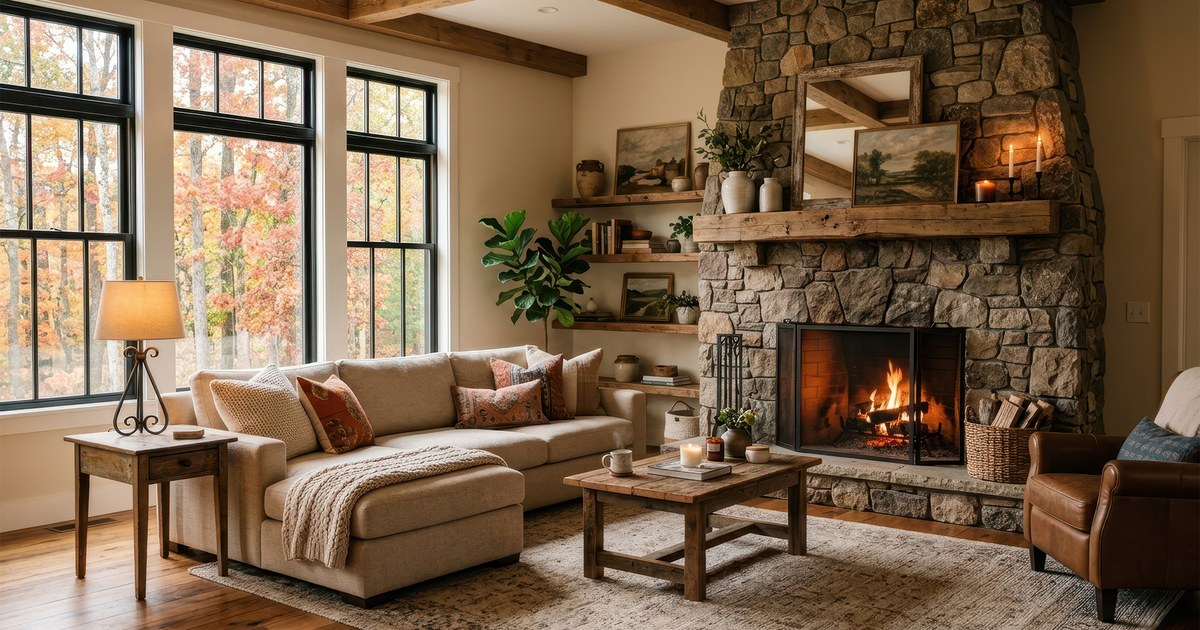
Plenty of homes across Blair, Bedford, and Huntingdon County still run a wood or pellet stove as a primary or backup heat source. It is a good way to heat a house. It also creates conditions in that room that almost no carpet buying guide accounts for, because most of them assume a furnace pushing even air through ducts.
The team at Cove Flooring & Design LLC sees the results of that gap fairly often, usually a few years in, when one section of a carpet has aged noticeably faster than the rest of the room.
Why stove heat asks more of a carpet than a furnace does
A furnace or heat pump distributes warmth fairly evenly through a room. A stove does not. It is a point source throwing radiant heat outward, so the floor within a few feet of the hearth runs consistently warmer than the floor across the room. Sustained warmth in one zone, year after year, can shift colour in the fibre nearest the stove while the rest of the carpet stays put. The result is a room that ages in patches rather than evenly.
This is where fibre construction does real work. Solution dyed fibre has pigment locked in when the fibre is made rather than applied to the surface afterward, so it holds colour far more consistently under sustained heat and light exposure. The same zone usually takes the heaviest foot traffic too, since people naturally cluster near the stove, so density is worth paying attention to in the same breath as colour.
The static shock almost nobody traces back to the stove
Winter static gets blamed on carpet constantly, but the carpet is only where you notice it. The actual driver is low relative humidity, and stove heat drives indoor humidity down harder than most homeowners realise. A house that shocks you every time you touch a doorknob from December onward usually has a humidity problem rather than a carpet problem.
Most residential carpet made today includes a permanent anti static treatment built into the fibre itself, and it is worth asking to see that on the spec sheet rather than assuming it is there. Pairing a treated carpet with a humidifier running through the heating season does far more than swapping one fibre type for another. If static is already a frustration in your house, raise it while you are choosing, not after installation.
Ash and fines are a colour question before they are a cleaning one
Refilling a pellet hopper and emptying an ash pan both release very fine ash, and it does not stay near the stove. It drifts and settles across the whole room in a thin, pale layer that is easy to miss until light hits the floor at a low angle. Every stove owner deals with it regardless of how careful they are.
A solid, pale, smooth cut pile shows that settling clearly between cleanings. A textured carpet with tonal variation or a subtle fleck hides it far better, which keeps the room reading as clean without asking more of you. This is not a substitute for regular vacuuming, and nothing is. It simply changes how the room looks on the days between.
Where the carpet has to stop
Every stove has a required non combustible floor protector extending a set distance in front of and around the appliance, and that distance comes from the manufacturer's listing for your specific unit and from local code rather than any general rule of thumb. So the carpet in a stove room always meets a defined edge somewhere. That edge deserves a decision rather than an afterthought.
Some homeowners run carpet right up to a tile or stone hearth pad and finish the edge cleanly. Others carry a section of luxury vinyl or tile through the whole hearth zone and start the carpet further out, which handles dropped bark, ash, and the occasional scuff near the stove with less fuss. Both approaches work well. The one thing worth avoiding is deciding where the transition falls after the material has already been ordered.
Fibre type, density, and colour variation are all easier to judge with samples in front of you than from a description. Cove Flooring & Design LLC carries a wide range of carpet and can pull options suited to a room that gets heated hard in one corner and lives normally everywhere else.
Our showroom sits in Martinsburg, PA, and we serve homeowners across Martinsburg, PA. Stop by Martinsburg, PA to compare textures and tones in real light, or contact us to ask about specs before you order.


